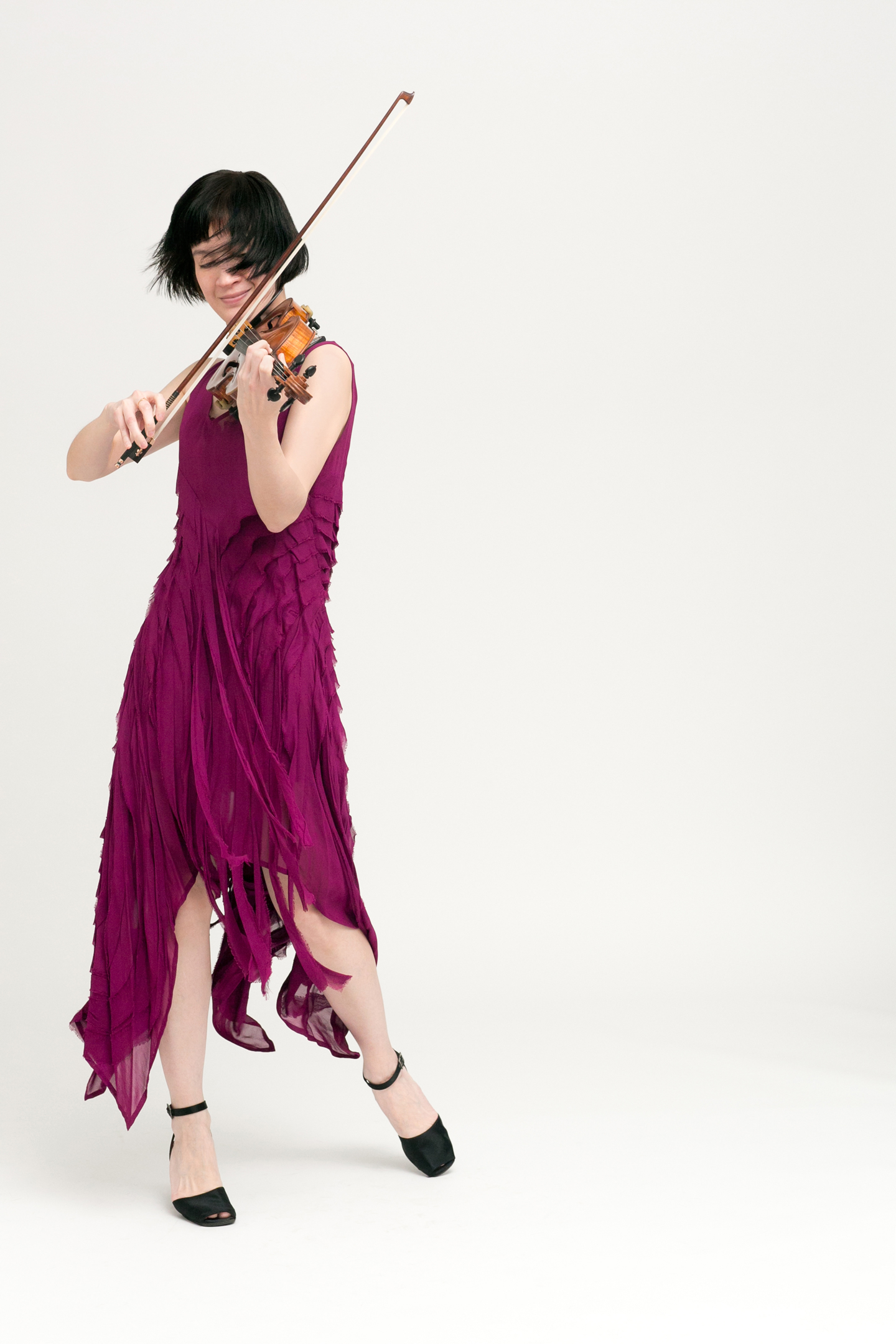
The violin part of Melting the Darkness was written and recorded first. Robert Rowe then created the electronics as a commentary on the violin part using processed fragments of the violin-playing, samples of percussion instruments such as the tabla, and other synthesized sounds.
Melting the Darkness was written for Miranda Cuckson. The piece is built around contrasting styles of music and performance, ranging from gritty, rhythmic phrases to more lyrical and slowly shifting sonorities. These contrasts are amplified and elaborated by an electronic commentary consisting of fragmented and processed material from the violin performance, as well as a number of secondary sources. The title of the work comes from Shakespeare’s The Tempest (as it should when a piece is composed for Miranda).
Lidia Zielinska Rapsodia (2004)
Rapsodia—a ten-minute piece composed in 2004 for my daughter—originated in the human need for rhapsodic expression. My daughter Anna Zielinska was the first performer of the piece, with her ElectromAnia Project at the Gelderse Muziek Zomer Festival (Netherlands) in August 2004.
Rand Steiger Longing (2021)
Longing, for violin and electronics, is the third in a series of pieces that explore and externalize inner emotional spaces. Composed during the pandemic in a period of isolation, it began as an attempt to give voice to my sense of longing for the connections and collaborations that became impossible at that time and evolved into a series of varied reflections on longing: longing for connection, for freedom, for hope, for love, for transcendence. But there isn’t specific material calculated to reflect each of those inner states. Rather, it was a way to enrich my musical voice by thinking about the way these things feel and letting them inspire sonic responses in a free-associative way.
The electronics are generated in real time, mostly based on transformations of the live violin sound, disseminated over eight speakers to create a more immersive experience by echoing, harmonizing, resonating, and spatializing the sound of the violin. As always, I am grateful to my friend Miller Puckette for his programming environment Pd that has enabled me to create the signal-processing programs for many of my pieces.
Diego Tedesco Portrait Number 1 (2020)
Portrait Number 1 emerged in the middle of the pandemic and is a product of the isolation and confusion caused by that dystopian situation. It is a work for violin and fixed electronics—my first work with electronics, and the first in which I felt synaesthetically that I was drawing with sound in time. As for the electronic sounds, I resorted to discarded material (I am not referring to secondhand sounds but to what could be taken today as technological scrap), perhaps as a manifestation of my critical view toward what someone called the ‘race weapons’ in electronic music, toward that future that becomes obsolete with the mere passing of the years, toward novelty for novelty’s sake. The choice of sounds implicitly criticizes the dehumanized society that brought us here.
Three natural harmonics of the violin begin the work. Then the electronics are added in a playful counterpoint which develops into diverse situations in which hierarchies are subverted again and again, where nothing is what it seems and where there is also humor. And from an even more general point of view, two concerns with formal discursive and material implications—drama and plasticity—fill and configure the work and its way of unfolding over time.
Portrait Number 1 begins my series of pieces for solo instrument and electronics, a tribute to Mario Davidovsky’s famous Syncronismos.
Kaija Saariaho Frises (2011)
Frises was born of a request by violinist Richard Schmoucler, who told me his idea of combining different works around Bach’s Partita for Violin No. 2, particularly in relation to the last part—the Chaconne. He asked me to compose a piece to be performed after Bach’s Chaconne and to start it with D, the note that ends that Partita movement.
My piece has four parts. I focused in each of them on the idea of one historical ostinato variation form, using carillon, passacaglia, ground bass, and chaconne as starting point. There are four variations around a theme, a harmonic process or other musical parameter. Expanding the ideas and possibilities of the instrument, I added an electronic dimension to the work. According to its character, each part has a different processing. In general, and in accordance with the score, prepared sound materials are set off by the musician during the piece. These materials are completed by real-time transformations of the violin sounds.
My aim in composing this piece was to create a rich work for violin with four very different and independent parts. Frise jaune is a prelude, a flexible improvisation around a constant D, colored by harmonics and the electronic part consisting of bell sounds. . . . Frise de fleurs is based on a harmony created on a ground bass. Sequences of successive chords are gradually enriched before opening to achieve a more free and lyrical development. Pavage is inspired by transformations of a source material by a mathematical process where a frieze is a filling of a line or a band by a geometric figure without holes or overflow, like paving, but not work in the sense of perfect symmetry. . . . Frise grise is like a strange procession, solemn, fragile. . . . The thematic material evolves, descending slowly from E—the highest string—to G, the fourth string. The music finally reaches the initial D in double stop which takes us back to the beginning of the piece.
The titles are inspired by the mathematical ideas mentioned above but also by Odilon Redon’s painted friezes—especially Frise jaune, Frise de fleurs, and Frise grise.