
Alarm Will Sound: Haas


Friday, August 21, 2026
7:30 pm

Mary Flagler Cary Hall

Georg Friedrich Haas
in vain, 2000
for 2 flutes, oboe, 2 clarinets, bassoon, 2 horns, 2 trombones, 2 percussion, harp, accordion, piano, saxophone, 3 violins, 2 violas, 2 cellos, and double bass

Alarm Will Sound

Alan Pierson, conductor

Erin Lesser, flutes
Brandon Patrick George, flute
Christa Robinson, oboe
Bill Kalinkos, clarinet
Nuno Antunes, clarinets
Ed Rosenberg, saxophones
Michael Harley, bassoon
Laura Weiner, horn
Nicolee Kuester, horn
Michael Clayville, trombone
Tim Albright, trombone
Chris P. Thompson, percussion
Matt Smallcomb, percussion
John Orfe, piano
Courtney Orlando, violin
Christopher Otto, violin
Austin Wulliman, violin
Andrew Griffin, viola
John Pickford Richards, viola
Irène Han, cello
Jordan Bartow, cello
Pat Swoboda, bass
Jacqui Kerrod, harp
William Schimmel, accordion
Daniel Neumann, Audio Engineer

Concert duration: approx. one hour and fifteen minutes

Alarm Will Sound’s performance of Georg Friedrich Haas’ in vain is made possible with the friendly support of the Ernst von Siemens Music Foundation.

Alarm Will Sound gratefully acknowledges our individual donors and the following foundations for their support: Aaron Copland Fund for Music, Amphion Foundation, Alice M. Ditson Fund of Columbia University, BMI Foundation, Cheswatyr Foundation, Fan Fox and Leslie R. Samuels Foundation, Howard Gilman Foundation, New Music USA’s 2026-27 Organization Fund, and the Sinquefield Charitable Foundation.

Additional support provided by public funds from the New York City Department of Cultural Affairs in partnership with the City Council; the New York State Council on the Arts with the support of the Office of the Governor and the New York State Legislature; and the National Endowment for the Arts.

Mary Flagler Cary Hall
DiMenna Center for Classical Music
450 W 37th Street
New York, NY 10018

More About
Georg Friedrich Haas
Alarm Will Sound
Program Notes

Georg Friedrich Haas
in vain (2000)

Georg Friedrich Haas’s in vain is a reflection on the inevitability of cycles of authoritarianism, and the ever-present need to push back. It has been called a modern masterpiece by Alex Ross and one of the first masterpieces of the 21st century by Sir Simon Rattle.

Haas grew up in a Nazi family and subscribed to the National Socialist ideology in his youth. But he turned away from this outlook in his twenties and came to see his compositions as a way to work through his “huge feeling of guilt” at his Nazi roots. Haas believed that the Austrian people had collectively turned away as well. So, when the right-wing populist Freedom Party surged back in Austria’s 1999 election Haas was deeply disturbed, seeing the moment as a “return to a situation believed to have been overcome.”

in vain is Haas’s reflection on this situation: music in which peace is repeatedly achieved, only to unravel again and again. The work begins with a maelstrom of descending notes and dissonant, unsettled harmonies which eventually settle into a static and dark place. The darkness here is not merely musical—the opening’s dissonant harmonies freezing into slowly diverging unisons—but also literal: this is the first of two sections of the work performed in darkness. Haas uses darkness to catalyze novel kinds of listening and playing. With the players unable to see their music, the conductor, or one another, Haas had to develop unconventional ways for musicians to play together.

As light returns, the music seems to have overcome the opening’s chaotic dissonances to achieve peace: silences separated by pure, otherworldly harmonies. These harmonies are in just intonation, created not out of the rational equal-tempered notes of the piano keyboard, but the pure, resonant intervals of the overtone series. Just intonation harmonies are at once alien—at odds with what we hear in most music—and also strangely familiar, because they are rooted in the fundamental nature of sound.

In in vain, Haas uses just intonation to express peace and purity achieved when the maelstrom is tamed. But this peace is unstable. The just-tuned harmonies inexorably descend, like a slow-motion version of the swirling descents of the opening. And tensions arise. Players swell against one another, bend pitches away from the pure harmonies, or separate entirely into conflicting chords. Even when rising melodic lines struggle against it, the descent continues. (Haas uses the ‘Shepard Tones’ technique to create the illusion of an infinite, never-ending descent.)

Gradually but inevitably, the “situation believed to be overcome” always returns. Haas describes this returning maelstrom, like the Freedom Party’s rise in 1999, “not as a triumphal reprise, but rather as the return of an oppressive, catastrophic condition.”

— Alan Pierson

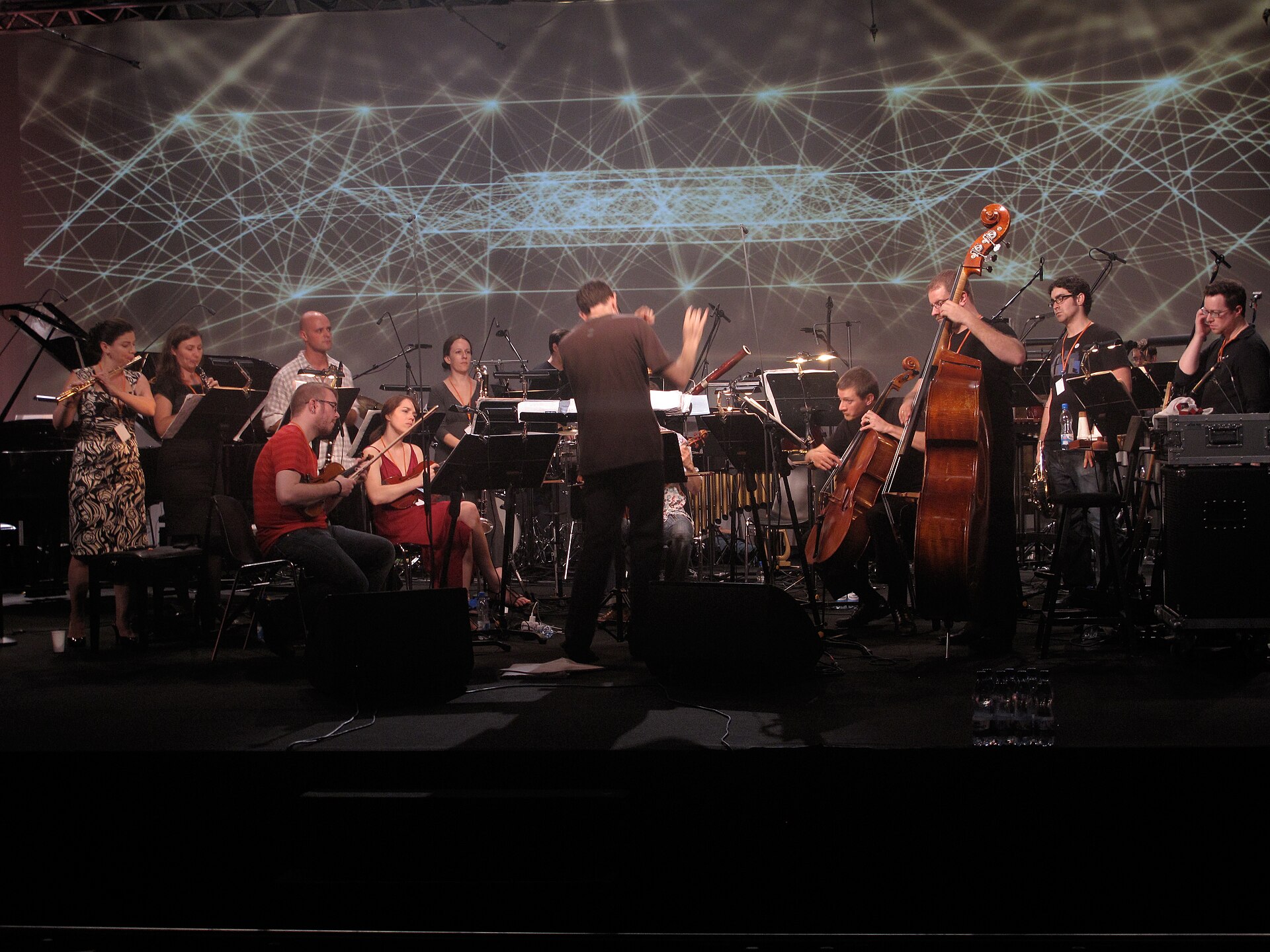
Alarm Will Sound. Photo: Michael Clayville

Join our mailing list