Melinda Wagner Limbic Fragments, 2024* for flute, oboe, clarinet, saxophone, horn, harp, piano, 2 percussion, 2 violin, viola, and cello * NY Premiere
Sean Shepherd Simple Machines - Air, Churn, Hover, 2024* for flute, oboe, clarinet, saxophone, horn, harp, piano, 2 percussion, 2 violin, viola, and cello * NY Premiere
Ramon Lazkano A Glitch at the Edge, 2024* for flute, oboe, clarinet, saxophone, horn, harp, piano, 2 percussion, 2 violin, viola, and cello * NY Premiere
Frédéric Durieux Theater of Shadows I, 2022* for flute, oboe, clarinet, saxophone, horn, harp, piano, 2 percussion, 2 violin, viola, and cello * NY Premiere
Augusta Read Thomas Solstice Ritual – Homage to Varèse and Ravel, 2024 for flute, oboe, clarinet, harp, piano, celeste, 4 percussion, 2 violin, viola, and cello
Grossman Ensemble
Timothy Weiss, conductor
Constance Volk, flute Andrew Nogal, oboe Katherine Jimoh, clarinet Taimur Sullivan, saxophone Matthew Oliphant, horn Greg Beyer, percussion John Corkill, percussion
Kyle Flens, percussion
Christopher Jones, percussion Ben Melsky, harp Daniel Pesca, piano Marianne Parker, celesta Hanna Hurwitz, violin Theo Ramsey, violin Doyle Armbrust, viola Nick Photinos, cello
Concert duration: approx. one hour and ten minutes
All works were commissioned by the Chicago Center for Contemporary Composition, except Solstice Ritual – Homage to Varèse and Ravel by Augusta Read Thomas, which was commissioned by the Juilliard School.
The limbic system is an immensely elegant and sophisticated network of interconnected brain structures that regulate certain features of human behavior, emotions, motivation, and arousal—as well as the formation and storage of memory. I’m intrigued by the notion that episodic memories, when connected to strong emotions, become eligible for long-term storage in the brain, while other less important memories tend to fall victim to routine neurological ‘housekeeping’. I have come to believe that stored ideas are very much alive, and continue to evolve, independent of us, even while we are performing mundane tasks—or sleeping. This miracle is an essential part of the creative process: composers, in particular, must remember not only the sounds around them, but also their own incipient, evolving ideas—while creating a new piece.
Limbic Fragments seemed an apt title for a work that involves a series of energetic, yet largely inconclusive episodes, whose ‘loose ends’, I hope, serve to increase the momentum of the music from one section to the next—similar, perhaps, to the way memories sometimes come at us, cascading and tumbling over each other, fast and furious.
Sean Shepherd Simple Machines (2024)
If one applies a scientific definition and notions of pulleys and levers, the above is probably more of a misnomer than a title. And yet, it does usefully describe what I believe I’ve made with these three short abstract sketches. Each movement takes as its point of departure an elemental concept in music—gesture, line, and harmony respectively—and, rather than run with it, tends to fixate. While the music in each cannot correctly be described as developmental, there is also little in the way of a calming stasis. These little machines run dutifully, chaotically, obsessively in their frustrated and relentless actions, until they just simply quit.
I joyfully dedicate Simple Machines to Augusta Read Thomas and David Dzubay, two dear mentor composers whom I’ve known and deeply admired for nearly my entire life in music, who together bring the piece into existence in every literal and figurative way.
Ramon Lazkano A Glitch at the Edge (2023)
The unexpected commission of this piece was a breach in the continuity of the mutating sound emerging in my last works. The unusual ratio between the number of players and its total duration has also been a challenge. This fragment operates as an introspective tool, recalling the instrumental means of my recent works and their obsolescence. The composer becomes a funambulist in search for an improbable balance, and his tightrope the metaphor of the malfunction of an instrumental and temporal set. Signals with elusive meaning, familiar figures unable to remain still, transient rhythms chaining the continuity of an uncomfortable sound, give shape to this inner listening impossible to be grasped. The exhaustion of the effort to hear the inner vibration of the sound in us reminds us of Sloterdijk: the thought ripples the soul like the finger plucks the string.
Frédéric Durieux Theater of Shadows I (2022)
In memoriam Christian Boltanski
Upon learning of the death of the visual artist Christian Boltanski in 2021, I wished to pay tribute by composing a work dedicated to his memory. For more than thirty years, I have followed his work with great interest, and his œuvre has always seemed to me among the most remarkable in contemporary art of the past fifty years. The news of his passing reached me just as I was beginning work on a score commissioned by the Chicago Center for Contemporary Composition; I therefore sought out a particular work by Boltanski that might more directly stimulate the compositional process.
Very quickly, my attention turned to the installation Théâtre d’ombres [Theater of Shadows, 1984–1997], which exists in several versions and which I had encountered in two different venues. Highly dreamlike and almost childlike in appearance, this installation is nonetheless profound. It evokes Hebrew traditions as much as Plato’s Cave, prehistoric cave paintings, or the puppet theaters found notably in Asia. It also reconnects with a wide range of mythologies and cultures from the West, South America, Asia, and Africa.
As I began my work, I recalled the moment when Boltanski’s installation is set in motion: the various figurines, projected onto the walls surrounding the spectators, slowly begin to move because of the heat emitted by the lamps. These initial movements suggested to me a form of shamanism, as if spirits—or the memory of those who have passed away—were being summoned. I also thought of Boltanski’s work which often takes the form of rituals linking the living with the dead.
The piece opens with uncertain sonorities that gradually transform into precise and highly articulated rhythms, then evolve toward complex harmonic situations, before finally releasing chants that seem to originate in Middle Eastern traditions. A kind of danse macabre gradually takes shape, before freezing and returning to the initial state.
This work was composed thanks to the generosity of Sanford and Navah Grossman, whom I warmly thank. I also wish to thank Augusta Read Thomas, who initiated this project, and to extend my warmest thanks to all the remarkable musicians of the Grossman Ensemble of Chicago.
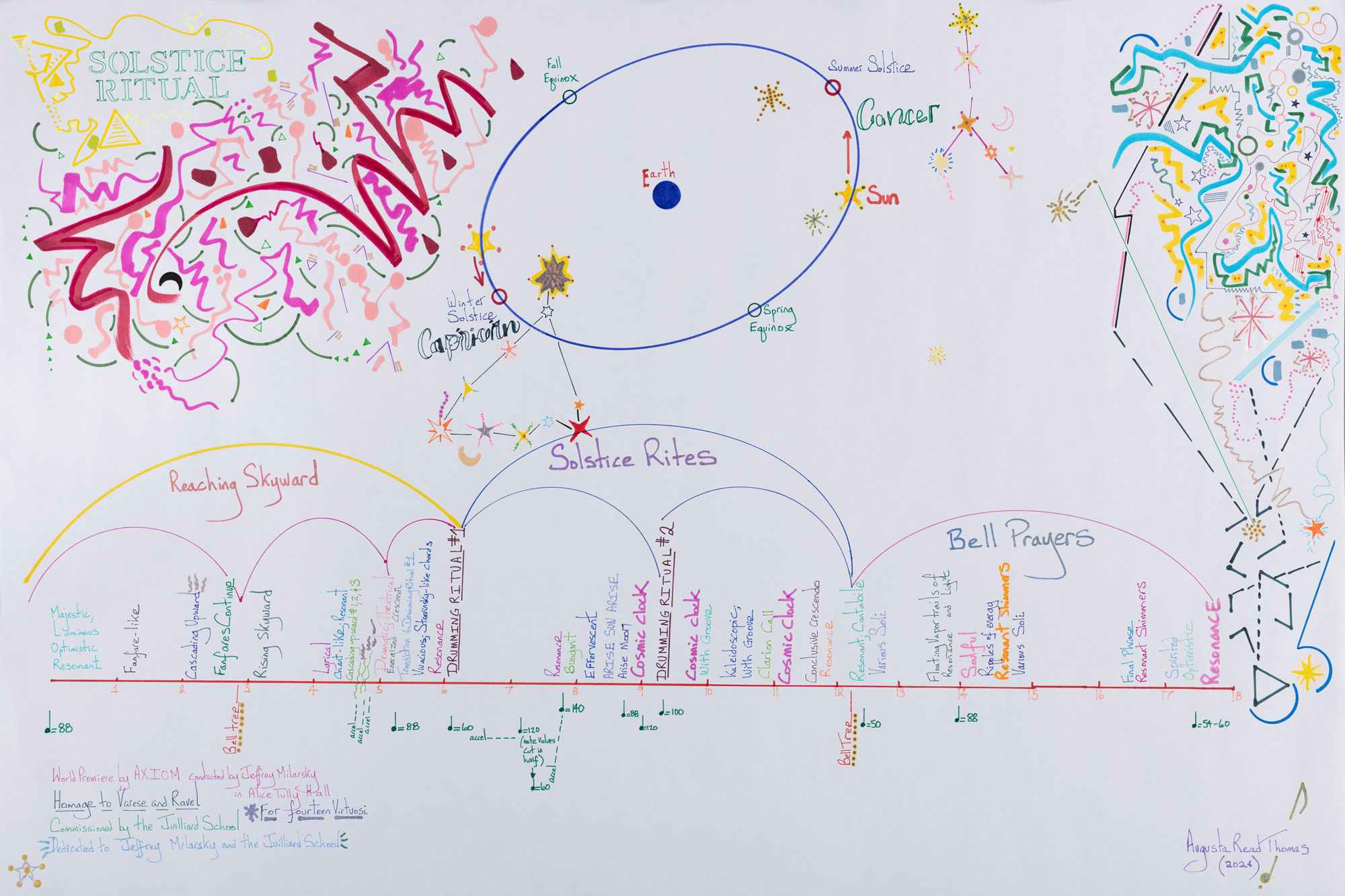
Augusta Read Thomas. Visual images of Solstice Ritual
Augusta Read Thomas Solstice Ritual—Homage to Varèse and Ravel (2024)
Over the past forty-five years, I have composed many works whose titles point to natural and celestial radiances: galaxy, star, sun, earth, moon, sky, light, dawn, illumination, equinox, summer, etc. One central metaphor of my life’s creative work is that of light refracting. Of interest to me, for my work, is to build, sculpt, and compose clean, clear, transparent, translucent, luminous, radiant, shining, resounding, and resonant musical materials.
Solstice Ritual—for 14 virtuosi—shares many of these preoccupations. The solstices . . . are the days when the sun’s path in the sky is the farthest north or south from the Equator. . . . I asked myself what kind of musical ritual I might compose for musicians to perform at the exact time of a solstice. The result is Solstice Ritual. . . .
As I composed Solstice Ritual, in my mind’s ear and eye were sonic and visual images of fourteen musicians, a conductor, and dancers, performing outdoors (if feasible) during the precise moment of a solstice. . . . Although the score took most of its inspiration from the vivid illuminations and dazzling rays of the summer solstice, at times it explores contrasting materials whose shadowy character may also suggest the relative absence of light that marks the winter solstice.
A related sonic and balletic image I had when composing this composition was that of a kaleidoscopically radiant light refracting with vibrant and multi-shaped energies in a constant state of transformation. The music’s energy-flows vary and braid together musical materials that are blazing, radiant, kinetic, ritualistic, resonant, lyrical, rhythmic, reflective, fiery, avid, dynamic, effervescent, and, at times, harmonically jazz-like. Importantly, Solstice Ritual was not conceived of as an ensemble piece. Rather, it is a score for fourteen highly virtuosic soloists.
Solstice Ritual also pays homage to the composers Edgard Varèse and Maurice Ravel, celebrating their imagination, joy, love, vitality, soul, energy, great chords and rich chord progressions, resonant orchestrations, tight big-bandlike splash-chords, and the sheer beating-heart inner life of their music. I love all of their compositions and to give just two examples among many, Varèse’s percussion writing and Ravel’s gorgeous orchestrations have been longstanding sources of inspiration. . . .
Although my music is meticulously notated in every detail, I like it to sound like it was spontaneously invented—always in the act of becoming. The creative journey—not a predictable or fixed point of arrival—is, for me, essential. I dance while I compose, hoping that my music will feel organic and self-propelled. I work hard to ensure that my music too dances; I often create in my mind and ear imaginary flexible dances and ballets, poems, visual-art doodles, lighting, or animations, and I love virtuosic performances that percolate and spiral with natural musicality. I draw maps of form and never follow them! Rather, I follow the music where it needs to go and then redraw the maps of form over and over and over.