Farzia Fallah I did not paint the war. I lived the war. - une Aubade, 2025* for flute, oboe, clarinet, bassoon, horn, trumpet, trombone, tuba, piano, percussion, violin, viola, cello, and double bass * US Premiere Commissioned by Ensemble Musikfabrik, Christine Schug-Mewes and Joachim Mewes, and Muziekgebouw aan ’t IJ with the support of Ammodo.
Márton Illés Forajzok , 2021* for flute, oboe, clarinet, bassoon, horn, trumpet, trombone, percussion, piano, 2 violins, viola, cello, and double bass * US Premiere
International Contemporary Ensemble
Rebekah Heller, conductor
Isabel Lepanto Gleicher, flute Jasmine Daquin, oboe Emmalie Tello, clarinet Alexander Davis, bassoon Erin Rogers, saxophones Nicolee Kuester, horn Gareth Flowers, trumpet Michael Lormand, trombone Marcus Rojas, tuba Modney, violin Leah Asher, violin Wendy Richman, viola Irène Han, cello Randall Zigler, bass Nuiko Wadden, harp Ross Karre and Clara Warnaar, percussion Erika Dohi, piano
Concert duration: approx. one hour and ten minutes
Mary Flagler Cary Hall DiMenna Center for Classical Music 450 W 37th Street New York, NY 10018
In ochre song, I hoped to apply physical material as a metaphor for sound material. I was especially interested in exploring the concept of layers, both physical and sonic. How does this material react when in contact with another? How is this sound color (or indeed our perception of it) impacted by its proximity to another? To that end, I established three main categories of layers in ochre song: grainy, fluid, and earthy. These layers are presented in a variety of configurations which reflect what I imagine would be the outcome of, for example, granular particles mixing with fluids, or how the ratio of one material to another would affect their resultant properties. The sonic gestures that represent these ideas are based on my own intuitive musical response to the material in question. For example, the log drum, temple blocks, and prepared harp-strings could, in certain contexts, represent granular material, whilst slow, bowed glissandi in the double bass, or the sound of a friction mallet being drawn across the skin of a bass drum, may embody the ever-changing quality of the earth beneath us. In ochre song I was also able to revisit my earliest experiments in music-making from almost two decades ago when I would mix and match pre-recorded objects in a Digital Audio Workstation, building layers of sound one track at a time. The work’s horizontal elements (say, the structure) rely heavily on the established associations between gestures and colors across the roughly fifteen different sections that make up the work. Form, then, becomes a string for tying together this musical omnium gatherum.
Imsu Choi Pop (2023)
The title is from the source of the sound that I made for the electronic part which is a popping sound. At that time, I was at Ircam for the Cursus program, and I was working with a motion sensor called R-IoT, a body-based media interaction. The process of the sound making that I appreciated therefore is organic and became the starting point of the piece. The electronic part is based on the improvisation of myself equipped with the sensor that I mapped with various parameters to trigger, modulate, and transform the sounds. A brief sound motif, a popping-like sound, becomes progressively a texture to fill the space and flows freely.
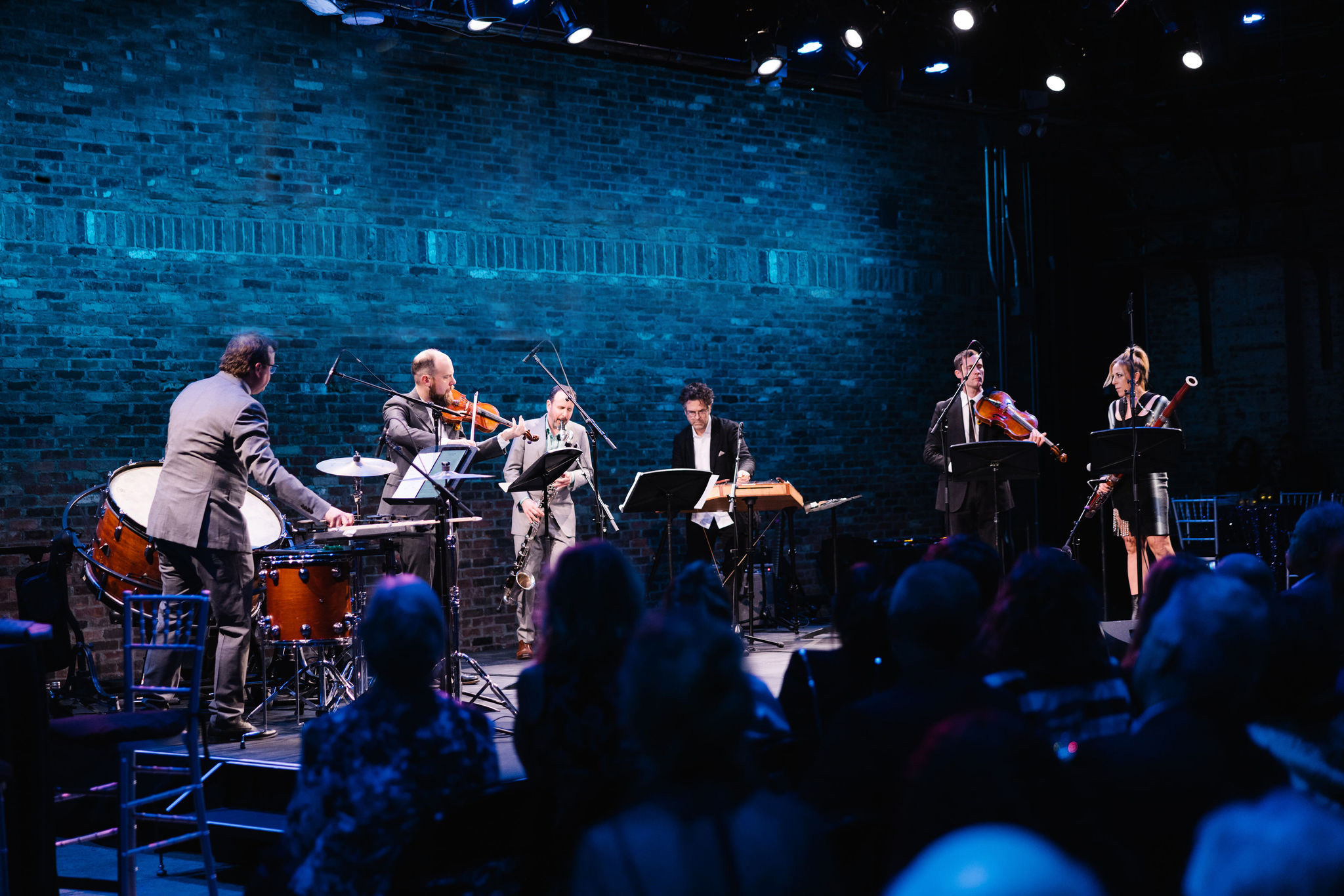
International Contemporary Ensemble. Photo: Da Ping Luo
Farzia Fallah I did not paint the war. I lived the war—une Aubade (2025)
I didn’t paint the war . . . but there is no doubt that the war exists in the paintings I made at the time. So said Picasso, about his painting, L’Aubade (1942).
As well as L’Aubade, in Paris, I also saw Dora Maar’s photos of Guernica, which documented the course of its creation. I was struck by how Picasso had transformed a raised fist—which, like a kind of rallying cry, holds a tuft of grass up to a sun—into a horse with its mouth wide open. The sun then became a lantern. What a horror. What a scream. What misery. And all of it so shamefully current, as H. might have said. I thought of lines from Henri Michaux’s poem, “Full Of:”
Full of shards, of debris, of heaps of debris, of cries as well, especially cries.
Paris was different. There, I sang everything I could, for a different Middle East, for Syria: Canti di una possibilità. And after returning from Paris, after those twelve days, after the missile struck the prison with pinpoint accuracy, after all that, I decided on the title of the piece and asked myself what G. might still have written. And whether it was a coincidence that I came across a poem by my father, Karim Fallah Rajabzadeh, at the very same time I was thinking about L’Aubade:
. . . Even if there is no-morning, be the morning glow yourself.
Márton Illés Forajzok (2021)
Rajzok (Drawings) is a series that by now comprises half a dozen autonomous compositions whose focus lies predominantly in the experimental domain. One member of this family is Forajzok, whose title alludes to the premiere ensemble Klangforum Wien. The work operates with radically diverse sonic means. Its texture, consisting of both conventional and extended instrumental sounds and characterized by vocal-like, archaic psychophysical qualities, is expanded and intensified through the addition of actual vocal sounds. Gestures, lines, and processes emerge, along with homogeneous and heterogeneous sonic planes as well as algorithmically generated harmonic progressions in a wide range of colors, densities, and intensities, unfolding subtly and in manifold ways within an organic alloy of instrumental and vocal sound. Furthermore, the work features sounds produced by coins struck against one another, rubbed, and scratched in various ways; through this, the piece acquires an additional theatrical as well as conceptual dimension.