It is a music of the vanishing. It is the revelation of the most fragile, unstable compositional between-time-spaces and their idiomatic, sonic, phenomenological, spatial, and temporally correlating signatures.
These were investigated using sonograms (Fast Fourier Transformation) of the most fragile sonic phenomena (including decays) that had previously been recorded. In this way, all compositional signatures of the piano part were revealed, developed, derived, analyzed, and typologized. On the one hand, this exposes the extreme structural instability of these compositional between-time-spaces, between correlating results and artifacts (the sonograms). On the other hand, the setup of the electronics and the files of those new, most unstable, most fragile signatures of the recorded score fragments were combined with concrete sound signatures of recordings from the Berlin Charité, from the Tränenpalast at the former border crossing Bahnhof Friedrichstraße, from the Freiburg Cathedral Boys’ Choir, and the river Dreisam flowing through Freiburg. This results in a fully composed, de-concretized, neither-illustrative-nor-allegorical typology of sound traces of extreme existential, perhaps metaphysical, phenomenological, organizational, spectral, mark-making, ephemeral compositional instability. It reveals a finely composed music of leaving and passing away—of disappearing. The composition often involves interpolations of phenomenological micro-intervals and micro-sound colors. Ultimate de/re-territorializing, de/re-idiomatizing, de/re-concretizing compositional correlations unfold. These phenomena, thus uncovered from deep within, form the music in their vanishing, the music of the vanishing.
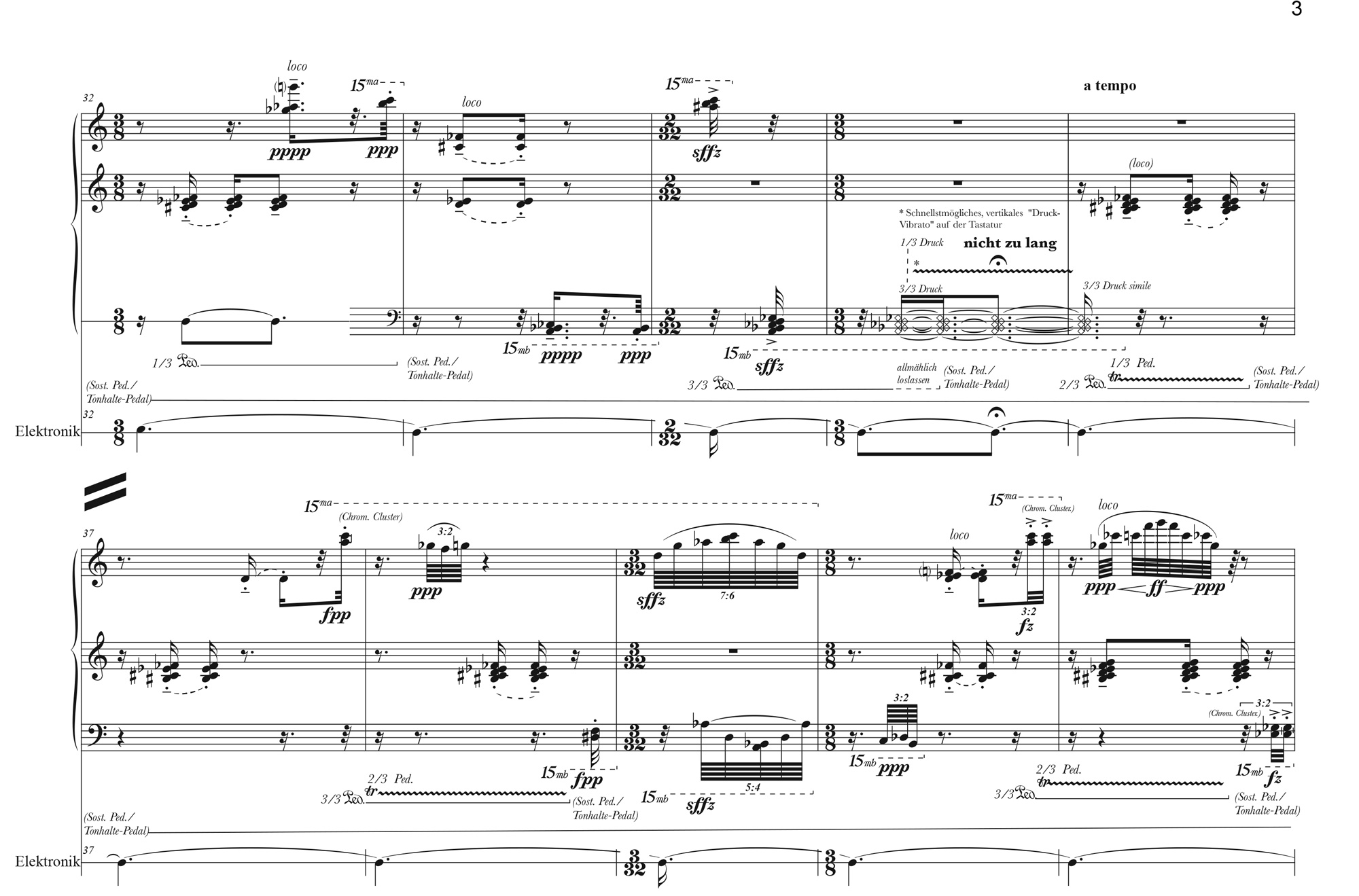
Mark Andre. A page from the score of . . . selig ist . . .
Vanishing is one of the most central themes of the Gospel message. It appears in the pericopes of the Passion, for example at the Last Supper in Emmaus or at the Ascension of Christ. The passage from the Gospel of Matthew quoted at the end of the score (Blessed are those who mourn, for they shall be comforted; Matthew 5:4) unfolds itself, in its compositional approach, in the sense of a music of remembrance for a deceased child.