Suzanne Farrin SEA-DRIFT, 2026* I. To the space in the door...
II. perdendosi
III. ...that opens and shuts. * World Premiere Co-commissioned by The Earle Brown Music Foundation Charitable Trust, The Banff Centre for Arts and Creativity 2019, and S., F., and A.
Parker Quartet
Daniel Chong, violin
Ken Hamao, violin
Jessica Bodner viola
Kee-Hyun Kim, cello
Concert duration: approx. one hour and ten minutes
Mary Flagler Cary Hall DiMenna Center for Classical Music 450 W 37th Street New York, NY 10018
György Kurtág Officium breve in memoriam Andreae Szervánsky, op. 28 (1989)
In fifteen short movements, Kurtág pays musical tribute to Endre Szervánsky, a fellow Hungarian composer, who was also deeply influenced by the work of Webern. Drawing inspiration from both Szervánsky and Webern, Officium breve serves as a Requiem Mass for the two, Kurtág even utilizing the Latin respelling of Szervánsky’s first name in the work title. Anchored by direct quotations from Szervánsky and Webern, Officium breve follows a rough arch form, where the central Webern-inspired music is enveloped by Szervánsky’s influence at either end.
Aus der Ferne III (1991) Aus der Ferne V (1999)
During the Cold War, the Viennese publishing house Universal Edition promoted Kurtág’s music in Western Europe (Editio Musica Budapest represented him on the other side of the Iron Curtain). Alfred Schlee was the highly influential head of Universal Edition for forty years, and the two Aus der Ferne works were written for Schlee: No. III in celebration of his ninetieth birthday, and No. V as a musical tribute after his passing.
Hommage à Mihály András: 12 Microludes for string quartet, op. 13 (1977)
As the title suggests, 12 Microludes pays homage to the Hungarian cellist and composer András Mihály, written in 1977 for his sixtieth birthday. Corresponding to a note in the 12-tone chromatic scale, each microlude is a distilled reality despite, or possibly enabled by, its extreme brevity.
Six Moments Musicaux, op. 44 (2005)
Its title reflective of Schubert’s eponymous collection of short character pieces for piano, Six Moments Musicaux was commissioned by the 2005 Bordeaux International String Quartet Competition. The first movement opens with passionate, biting leaps in all instruments. Each of these leaps is gigantic in span of interval and justly defines the notion of an invocation: a call to a higher deity or supernatural spirit.
Footfalls refers both to a play by Samuel Beckett, as well as a poem by the Hungarian poet Endre Ady.
Capriccio is the shortest of all the movements with a duration of just over a single minute. It catches Kurtág at his most light-hearted, humorous self. It is short, spiky, witty, and full of surprises. In memoriam GyörgySebök pays homage to Kurtág’s beloved friend and distinguished pianist György Sebök. The emotional arc of this movement clearly expresses his grief and his belief that Sebök’s spirit lived on.
Dedicated to Tabea Zimmermann, Rappel des oiseaux is a colorful land filled with bird calls, taking its cues from Olivier Messiaen, a past teacher of Kurtág’s, whose work included ornithological references.
Les adieux bids us farewell in the style of Leoš Janáček. With its rhapsodic freedom and pulsating grammar, the oscillating intervals are a perfect musical gesture of a hand slowly waving goodbye.
—Ken Hamao and Daniel Chong
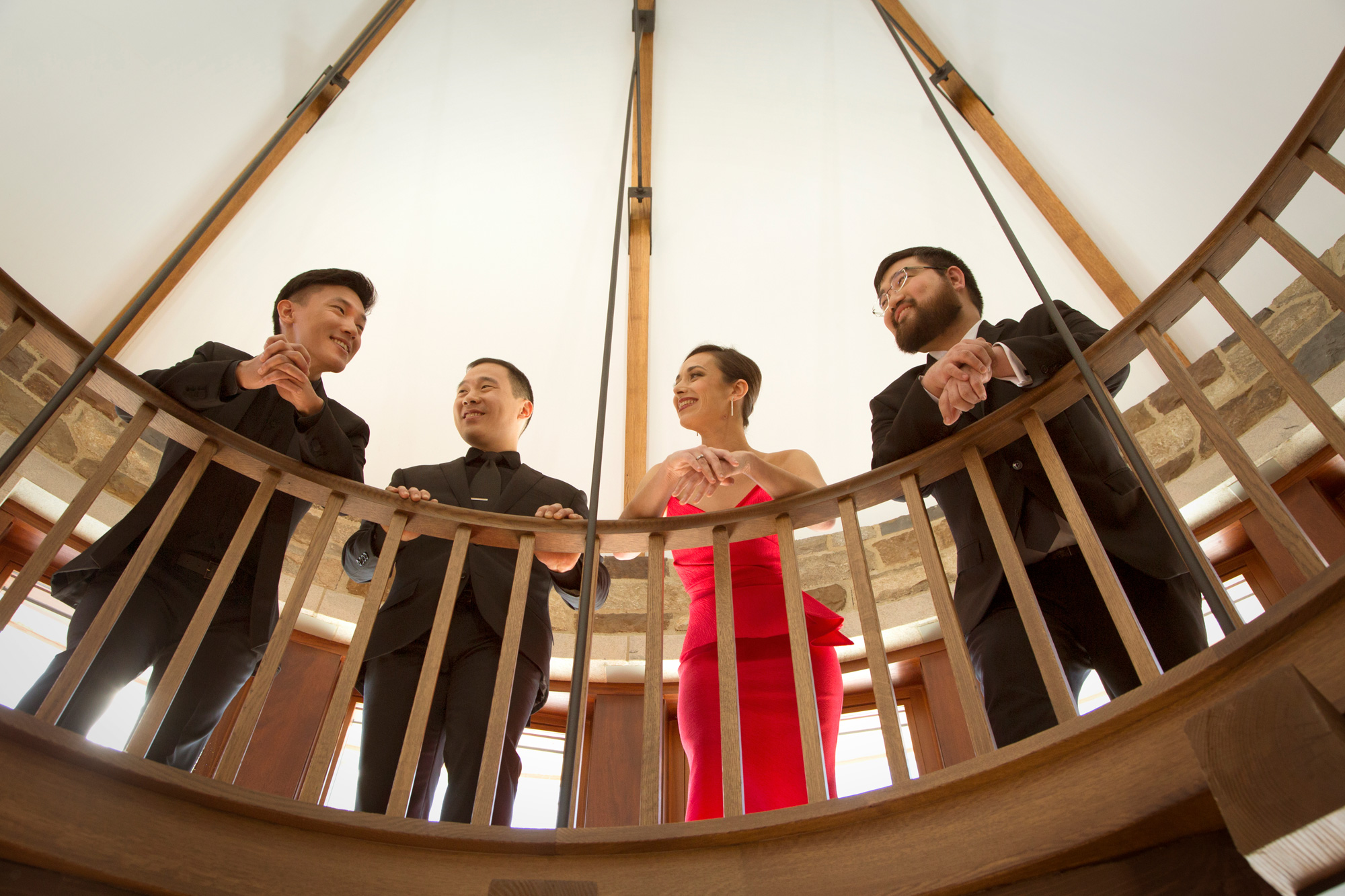
Parker Quartet. Photo: Luke Ratray
Suzanne Farrin SEA-DRIFT (2026)
The resonance that we experience between each other, living and dead, weaves into our musical psyche and imagination in untraceable ways. All of us, performers or not, embody what we hear for a time. It sits with us and tells us things about our humanity that were previously unconscious, and then it dives back down again. When its passage is complete, each vessel has been changed uniquely and forever. How do we experience, store, and speak through this new knowledge? What does it sound like when one composer shapes another? The love I have for the music of other people feels like a series of imprints, which are heard in what is left behind: the sound of our momentary togetherness.
For me, musical experience is like a meeting of the minds: the composer’s thought, living or dead, the player who filters and colors the message, and the listener, who finds their own liminal space in the dreams of others. This ‘meeting’ can come as a shock as it can stretch across hundreds of years and vast physical boundaries. It can include people I never knew I understood, or ideas that I didn’t think were consonant with my own. The power of this connection keeps my antennae up, searching the waves for a spiritual legato: the tiny thread to something beautiful or bewildering.
This work is a response to the music of György Kurtág and the Parker Quartet’s particular attention to his expressivity. It reads like one composer’s unanswered letter to translucence. References to his works visit in fleeting citation, but its essentialness comes through hollowed-out reverberations of what is left behind.